Disability Inclusion MOOC for HR Managers
Module 10 – Conflict Resolution and Problem-Solving
At the end of this module, learners will be able to:
- Identify common sources of conflict related to inclusion and diversity.
- Explain key conflict resolution models and techniques.
- Recognise why addressing issues early helps prevent escalation.
- Mediate conflicts with empathy, fairness, and neutrality.
- Develop problem-solving strategies that value different perspectives.
- Encourage open communication and trust within teams.
- Transform conflicts into opportunities for learning and growth
Theory
Think of a conflict you’ve experienced at work. What made it difficult? What helped to resolve it?
Conflict Resolution and Problem-Solving

- Inclusive workplaces are not free of conflict, but they approach it differently.
- Conflict resolution is about understanding different perspectives, finding common ground, and turning disagreement into growth.
- When handled with respect and fairness, conflicts can strengthen trust, spark creativity, and build better teamwork.
- Your ability to listen, stay neutral, and guide others calmly makes a real difference in creating a healthy, inclusive workplace.
Why Conflict Resolution and Problem-Solving Matters
- Constructive conflict builds stronger, more innovative teams.
- EU-OSHA (2022): Unresolved conflicts cause up to 30% of workplace stress and absenteeism.
- CIPD (2023): Organisations with trained mediators reduce grievances by 50%.
- Harvard Business Review: Teams that handle conflict openly are 2.6× more likely to outperform their peers.
- Inclusive conflict management creates fairness, trust, and long-term collaboration.
Activity 1 – Understanding Conflict in Inclusive Workplaces
Key Points
Conflict is natural where people think differently.
Misunderstandings, unclear expectations, or bias can make small issues grow.
Talking early and openly helps avoid escalation.
A safe environment encourages people to raise concerns calmly.
Facts
Around 85 % of employees experience conflict at work (CPP Global Report).
Only one in four feel confident managing it.
🟢 Reflection
Think about a time a small misunderstanding became a bigger issue.
What could have been done earlier to prevent it?

Ways to address a conflict
Thomas-Kilkmann Conflict Mode Instrument
The Thomas-Kilmann Conflict Mode Instrument (TKI) is a framework that helps HR managers understand five different styles of responding to conflict, based on how assertive and how co‑operative a person is in a given situation.
In the context of disability inclusion, it can be used to reflect on whether HR handles disability-related disagreements in ways that protect dignity, fairness, and participation of employees with disabilities.
The TKI maps conflict behaviour on two axes:
- Assertiveness = focus on one’s own needs and goals.
- Cooperativeness = focus on the other person’s needs and goals.
Crossing these axes creates five conflict modes; none is “good” or “bad”, but each is more or less suitable depending on context, power dynamics, and inclusion goals.
Thomas-Kilkmann Conflict Mode Instrument - The five conflict modes
(high assertiveness, low cooperativeness): Pushing one’s own solution or policy, useful in emergencies or when enforcing legal obligations (e.g. refusing discriminatory practices), but risky if it silences disabled employees’ voices.
(low assertiveness, high cooperativeness): Yielding to others to preserve relationships, useful when the issue matters more to the other party (e.g. adapting a process to an employee’s access needs), but harmful if HR always gives in to managers who resist inclusion.
(low assertiveness, low cooperativeness): Delaying or sidestepping conflict, sometimes appropriate for minor issues or when emotions are too high, but very damaging when HR ignores complaints about inaccessible recruitment, microaggressions, or harassment.
(medium assertiveness and cooperativeness): Finding a “middle ground” where everyone gives up something, useful for quick, workable agreements (e.g. phased implementation of accommodations), but may leave systemic barriers in place if overused.
(high assertiveness, high cooperativeness): Joint problem‑solving to fully meet both sides’ core needs, ideal for disability inclusion because it involves disabled employees in designing solutions and often leads to more innovative, sustainable changes.
Thomas-Kilkmann Conflict Mode Instrument
For HR managers working on disability inclusion, the TKI can be framed as a self‑reflection tool:
Ask: “Which mode do I default to when managers resist accommodations or when disabled staff raise concerns?”
and
“Does my style empower or silence employees with disabilities?”.
Inclusive HR practice requires consciously shifting toward collaborating and appropriate assertiveness to uphold rights, challenge ableist behaviour, and redesign policies with disabled people, while still using the other modes selectively when they genuinely fit the situation.
Ways to address a conflict
Other Instruments
- Several models beyond Thomas-Kilmann suit HR and company use
- Emphasis on practical styles, mediation, and workplace dynamics
- Support employee relations, team management, and conflict prevention in professional settings.
Mediation Frameworks – promote win-win outcomes and relationship preservation
- Interest-Based Relational (IBR) model: guides HR mediation by separating people from problems, focusing on interests, generating options, and evaluating objectively.
- RESOLVE framework (Recognize, Engage, Seek, Outline, Look, Validate, Evaluate) provides structured steps for HR-led discussions in employee disputes.
Process-Oriented Approaches – integrate well into company training for daily conflicts
- Harvard Negotiation Project’s principled negotiation (Getting to Yes): teaches objective criteria, BATNA (Best Alternative to a Negotiated Agreement), and mutual gains for HR negotiations.
- Crucial Conversations model: equips teams for high-stakes talks with safety-building techniques and shared meaning.
Barriers and Facilitators of Conflict Resolution and Problem-Solving
Barriers
- Ignoring conflict or delaying action
- Taking sides or showing bias
- Lack of trust or psychological safety
- Poor listening or emotional reactions
- Focusing on blame instead of solutions
Facilitators
- Address issues early and openly
- Stay neutral and show empathy
- Focus on shared goals, not positions
- Encourage respectful dialogue and feedback
- Use clear steps or frameworks for resolution
Psychological Safety
Foundation for genuine inclusion because people with disabilities often weigh the “risk” of disclosing needs against possible stigma or retaliation.
Amy Edmondson’s Psychological Safety framework
Explains how teams perform best when people feel safe to speak up with ideas, questions, and mistakes without fear of embarrassment or punishment.
It shows HR managers that inclusion is not only about policies, but about creating a climate where employees with disabilities can voice needs and concerns confidently.
Key definition
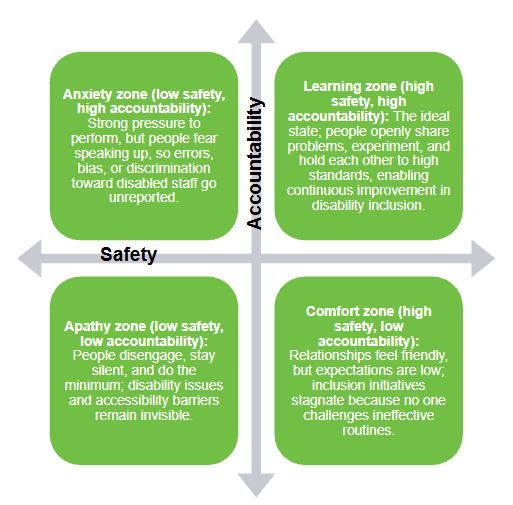
Psychological safety is the shared belief that “I can take interpersonal risks here – such as admitting an error, asking for help, or challenging a decision – without negative consequences for my image, job, or career.”
It is not about comfort or lowering standards; it combines respectful candor with clear accountability for high performance and learning.
Psychological Safety
Four zones of performance - Edmondson’s 2×2 matrix (Psychological Safety × Accountability)
Psychological Safety
What HR managers should do
- Set the stage:
- Explain that complex, diverse workplaces are uncertain
- HR needs everyone’s input, especially voices of employees with disabilities, to spot barriers and co‑design solutions
- Invite participation:
- Ask questions about invisible accessibility problems
- Actively solicit feedback from disabled employees, ERGs, and candidates about recruitment and workplace practices
- Respond productively:
- When people raise concerns, thank them, explore causes, and focus on learning and repair instead of blame
Build a learning culture where disability-related issues can be discussed early and honestly, leading to better accommodations, fairer decisions, and more innovative problem‑solving for the whole workforce.
Activity 2 – Common Sources of Conflict in Diverse Teams
Key Points
Unclear roles or goals.
Different communication or cultural norms.
Unequal access to information or decisions.
Lack of inclusion or respect.
Fact Box
In mixed teams, communication misunderstandings cause about 40 % of all conflicts (CIPD 2023).
Conflict and Disability in the Workplace
- Employees with disabilities may face misunderstandings or exclusion because their needs aren’t visible or well understood.
- Lack of accommodation or support can turn small issues into full-blown conflicts.
- Inclusive conflict resolution means recognizing and addressing accessibility, disclosure, and accommodation issues.
- When employees with disabilities feel safe to speak up, conflict is less likely to escalate.
Facts / Numbers
- Research shows that persons with disabilities report poorer working conditions, including more conflict or stress at work.
- A survey found organizations where disability-related disputes were handled via mediation saw better outcomes.
- Conflict at work overall: around 35% of employees in one large UK study experienced a form of interpersonal conflict in the past year.
Activity 3 – Conflict and Disability in the Workplace
Invisible or Misunderstood Needs
- Many disabilities are not visible — for example chronic pain, neurodiversity, or mental health conditions.
- When managers or colleagues misinterpret behaviour or performance, tension can grow.
- Lack of disclosure and understanding often leads to frustration or mistrust.
- Early, open, and confidential communication helps avoid unnecessary conflict.
- Fact:
- More than 70% of disabilities are invisible (WHO, 2022).
Activity 4 – Understanding Invisible Needs

Reflection:
Think of a workplace situation where someone’s needs were misunderstood.
What could have been done differently to prevent conflict?
Disclosure and Trust
- Many employees hesitate to disclose their disability out of fear of stigma or negative reactions.
- When issues arise, the lack of openness can complicate resolution.
- Creating psychological safety encourages early disclosure and faster support.
- HR and leadership play a crucial role by modelling respect and confidentiality.
- Fact:Nearly 48% of disabled employees worry about disclosing their condition to employers (Guardian, 2017).
Activity 5 – Building Trust
Q2. What builds trust in conflict situations?
✅ Confidential conversations, empathy, and consistent follow-up actions.
Quick Recap
- Handled openly and fairly, conflict can strengthen inclusion and teamwork.
- Different needs, communication styles, or expectations can cause friction. Awareness prevents it.
- Conflicts often arise from missing accommodations, not the disability itself.
- Safety and confidentiality encourage early, honest dialogue.
- Many disabilities are unseen. Understanding and flexibility make all the difference..
Decision Tree Exercise
Scenario Setup:
- You are the manager of a small team in a public service organization.
- Recently, a staff member named Alex, who has a hearing impairment, has been less vocal in team meetings.
- Another colleague, Mara, complains that Alex “doesn’t seem interested” and “isn’t contributing to group projects.”
- The tension is affecting morale, and a conflict seems to be forming.
You need to decide how to respond.
Practical Activity – Workplace Application Task
Activity 1: Observe and Reflect – Conflict and Inclusion in Your Team
Activity 1: Observe and Reflect – Conflict and Inclusion in Your Team
Activity Prompt:
Think about a time when tension or misunderstanding appeared in your team.
Was it resolved quickly, or did it grow into a larger issue?
This activity helps you connect what you’ve learned about inclusive conflict resolution to your daily work life.
Reflection Questions or Tasks:
- What were the main causes of the conflict (e.g. communication, workload, lack of clarity)?
- How was it handled — and by whom?
- Were all perspectives, including those of people with disabilities or quieter voices, considered fairly?
- How could inclusion and empathy improve future conflict resolution?
Estimated Time: 8 minutes
Format Reminder: Write your reflections in your notes or personal journal.
Activity 2: Design an Inclusive Conflict Resolution Plan
Activity Prompt:
Use what you’ve learned to create a short plan for handling a potential conflict in your team.
Focus on ensuring that the process is inclusive, respectful, and fair for everyone — including colleagues with disabilities or different communication needs.
Reflection Questions or Tasks:
- How will you make sure every voice is heard during the resolution process?
- What steps can you take to prevent bias or assumptions?
- What practical adjustments could support accessibility (e.g., written summaries, mediation support, flexible timing)?
- How will you follow up to ensure lasting understanding and trust?
Estimated Time: 10 minutes
Format Reminder: Record your plan in your organisation’s notes, HR tool, or your personal digital workspace.
Case Study
Case Study – Reflection
Now that you’ve read the case study, take a moment to reflect on the following:
Which practices from the German case study could be applied or adapted in your own organisation to strengthen trust and inclusion in conflict situations?
Think of a time when a misunderstanding about health, workload, or flexibility caused tension at work.
What could have been done differently to prevent or resolve it?
How can your team promote open dialogue so that everyone — including colleagues with disabilities — feels safe to speak up about their needs?
Estimated Time: 5–7 minutes
Write your reflections in your notes or learning journal..
Further Resources
Title | Type | Link | Why it‘s Useful (1 sentence) |
ILO (2021) – Managing Disability in the Workplace: A Guide for Employers | PDF / Report | Practical guidance on disability-inclusive policies, mediation, and workplace adjustments. | |
European Commission (2022) – Disability Employment Package: Guidance for Employers | PDF / EU Policy | EU-wide guidance on reasonable accommodation and inclusive conflict management. | |
EU-OSHA (2023) – Psychosocial Risks and Healthy Workplaces Campaign | PDF / Toolkit | Addresses workplace stress, communication breakdowns, and preventive approaches to conflict. | |
Sinus-Institut (2023) – Situation von Frauen mit Schwerbehinderung am Arbeitsmarkt | National Study (Germany) | Provides authentic, lived experiences of women with disabilities in German workplaces — highlights real conflict scenarios and solutions. | |
Inclusive Leadership and Communication – UN Geneva | Video (3 min) | Highlights why inclusive communication prevents misunderstanding and conflict. |
Sources and References
- European Commission (2022). Disability Employment Package: Guidance for Employers. Retrieved from https://ec.europa.eu/social/main.jsp?catId=1484
- ILO (2021). Managing Disability in the Workplace: A Guide for Employers. Geneva: International Labour Organization. https://www.ilo.org/global/topics/disability-and-work/WCMS_633736
- EU-OSHA (2023). Healthy Workplaces Campaign – Managing Psychosocial Risks. European Agency for Safety and Health at Work. https://osha.europa.eu/en/themes/healthy-workplaces-campaigns
- Sinus-Institut (2023). Situation von Frauen mit Schwerbehinderung am Arbeitsmarkt. Berlin: Bundesministerium für Arbeit und Soziales. https://www.sinus-institut.de/media-center/studien/situation-von-frauen-mit-schwerbehinderung-am-arbeitsmarkt
- Acas (2023). Disability Discrimination and Workplace Conflict Guidance. Advisory, Conciliation and Arbitration Service (UK). https://www.acas.org.uk/disability-discriminationBritish Columbia/Yukon PRESSBOOKS (n.d.). Thomas-Kilmann Conflict Mode Model. 4.5 Thomas-Kilmann Conflict Mode Model – Technical Writing Essentials – H5P Edition
- Russo, Hazel (n.d.). Module: Conflict Modes and how to use them. Module in Communication Skills for Supervisors. NHS Health Education England. Conflict-modes-an-introduction.pdf
- Baskin, Kara (2023). Four Steps to Building the Psychological Safety That High-Performing Teams Need. Harvard Business School. Four Steps to Building the Psychological Safety That High-Performing Teams Need | Working Knowledge
- McKinsey (2023). What is psychological safety? What is psychological safety? | McKinsey
Edmondson, Amy C. (2025). Psychological Safety – Amy C. Edmondson
End Of Module

Funded by the European Union. Views and opinions expressed are however those of the author(s) only and do not necessarily reflect those of the European Union or the European Education and Culture Executive Agency (EACEA). Neither the European Union nor EACEA can be held responsible for them.