Disability Inclusion MOOC for HR Managers
Module 2 – Fostering a Culture of Disability Inclusion
At the end of this module, learners will be able to:
Practical skills the course will help you develop:
- Recognise the role of leadership in driving inclusion.
- Assess the current organizational culture regarding disability inclusion: use diagnostic tools (climate surveys, physical and digital audits, interviews).
- Design strategies to promote inclusive values and behaviors: build training, communication and governance plans; define KPIs and monitoring mechanisms.
- Manage operational processes: design procedures for reasonable adjustments, inclusive hiring and responsible procurement.
Introduction: Definitions and Conceptual Frameworks.

Values and beliefs: These are the fundamental principles shared by employees that define what is important to the organization.
Practices and norms: The rules, policies and habits that dictate how tasks are carried out and how people interact day to day.
Organizational structure: The way the company is organized, including its hierarchy and leadership styles.
Human talent: The characteristics of employees, their expectations, motivations and the social environment they create.
Organizational environment: The physical work environment, the technology used and how the organization relates to its external environment.
Vision and mission: The direction the company sets for the future and the purpose of its existence
Other important Definitions
Creates a sense of belonging for members and helps them identify with the organization.
Defines the correct way to act, think and feel, influencing decision-making.
Serves as an internal mechanism to align collaborators with strategy and optimize functioning.
A solid culture can attract new talent and retain current employees.
It is a key factor for managing transformation and organizational adaptation to changes.
Work Culture and Disability

GSL (General Logistics System) is an example of an inclusive company.
GLS Spain offers specific training, adapted to the tasks of each new employee, removing entry barriers and facilitating full integration.
Their inclusion strategy comes from their Diversity Statement, a series of goals they have set.
Among them we can see : Guaranteeing equal Access to training and promotions. Promoting intergenerational and diverse teams, encouraging a respect-focused corporative culture. These are the foundations that strengthen internal cohesion and align them with the values that society demands: empathy, justice y social sustainability.
Introduction: Inclusion as Policy or Inclusion as Culture?
Brief listing of the elements that make up the culture of a company:
Values: Do the values of my company align with inclusion and equality?
Norms: Are there specific norms in my company “rulebook” regarding disability?
Symbols: Do the employees with disabilities see themselves represented in the organisation symbols?
Brief listing of the elements that make up the culture of a company:
Day to day practices: how is the day-to-day in your organization? Are people integrated or included?
Structures: Does the structure encourage the development and promotion of people with disabilities? Are there any people with disabilities in the upper levels of the organisation?
Resources: Do you believe that the company’s resources are effectively available to all employees, or are there resources that are difficult for a person with a disability to use?
The key difference is that inclusion as policy is a formal set of rules and procedures to ensure fairness and non-discrimination, whereas inclusion as culture is the actual, organic practice where all employees feel valued, heard and empowered to participate fully. Policy provides the structure, but culture is the behaviour and atmosphere experienced day-to-day.
The main objective should be to turn company policies into company culture.
Activity - Models of Disability: Which is the Underlying Model in your Organisation?
Think about any company you have worked for a moment and try to remember an example where the culture deviated from the stated policies.
Why do you think that happened?
Estimated time: 5-7 minutes
Write your reflection in your notes or learning journal
3 Models. Charity, Medical and Rights-based.
A model based on traditions and moral and/or religious beliefs. this approach coincides in part with the theoretical framework of the medical, rehabilitative or individual model, which has maintained the idea that “people with disabilities had to be treated condescendingly, institutionalised, cured or rehabilitated”
According to the medical-rehabilitative, having a disability is synonymous with possessing a defective, impaired or deficient body that conditions and restricts the life experience of the person with a disability.
Disability is attributed to the individual and is seen as a negative variation or deviation from the biological norm.
Barriers in the environment are what create disability; lack of accessibility obstructs. The problems faced by people with disabilities are not caused by their limitations but by the way society fails to organise itself in a way that allows people with disabilities to be included, shifting from being a medical issue to being a human-rights issue.
Think about this models and try to match the behaviours in organisations you know. How do people think? How prevalent do you think the 3 models are?
Estimated time: 5-7 minutes
Write your reflection in your notes or learning journal
Current State of Corporate Culture:
- Data from Deloitte (2024) reveals that disability inclusion in companies still faces cultural and operational resistance:
- 74% of people with disabilities who requested reasonable adjustments had at least one request rejected, mostly on cost grounds.
- More than 40% of employees have experienced non-inclusive behaviour (microaggressions, harassment or discrimination).
- The absence of visible leadership role models with disabilities limits identification and internal trust.
- Inclusion policies tend to be concentrated in HR departments, without comprehensive commitment from senior management.
Quiz
Economic and Market Factors
What is Universal Design?
Economic and market factors
Disability is an 18.3 trillion dollar market (including people with disabilities and their consumer environment). However, most companies have not yet capitalised on this potential because:
- They interpret disability from an identity perspective (compliance or reputation), rather than functionality or innovation.
- There is a lack of strategic leadership that embraces inclusion as a competitive advantage in design, talent and customer experience.
- Only large technology corporations (Alphabet, Apple) have managed to turn accessibility into a source of innovation and profitability.
- Therefore, the current economic context points towards a business redefinition of inclusion as a market opportunity and operational efficiency, not just a moral duty.
The European Commission's Impact Assessment already showed in 2015 that:
-
97% of Europeans support the full participation of people with disabilities in society.
-
However, more than 60% perceive persistent barriers in transport, ICT and the built environment.
-
Both citizens and businesses called for greater regulatory consistency, effective control mechanisms and specialised training for staff and SMEs.
This reflects the fact that, although social awareness has advanced, structural change in corporate culture continues to depend on committed leadership, continuous training and dedicated resources.
Tendencies Within the European Organisational Culture
Aspect | Current Situation | Main Source |
Visible Commitment | The number of companies with public diversity policies is increasing, but few link them to measurable results. | Deloitte, 2024 |
Universal Accessibility | Increasing regulatory compliance by the EAA, although with variability between Member States. | White & Case, 2024 |
Inclusive Leadership | Limited presence of leaders with disabilities; visible role models are needed. | Deloitte, 2024 |
Accountability | The Directive on corporate sustainability reporting introduces mandatory reporting on disability; still in the early stages of implementation.. | White & Case, 2024 |
Innovation from functionality | Leading companies integrate inclusive design into their R&D; most still see it as an expense.. | Return on Disability Group, 2024 |
Quiz
Conclusion
European organizational culture regarding disability inclusion is evolving from a welfare or compliance model to a strategic, sustainable, and value-oriented one.
The main drivers of change are:
- visible and responsible leadership,
- corporate accountability driven by new European directives
- the integration of accessibility into design, innovation, and talent.
However, cultural, perceptual, and resource barriers persist, hindering full inclusion. The current challenge is to move from awareness to institutional co-responsibility, consolidating an inclusive culture based on rights, sustainability, and competitiveness.
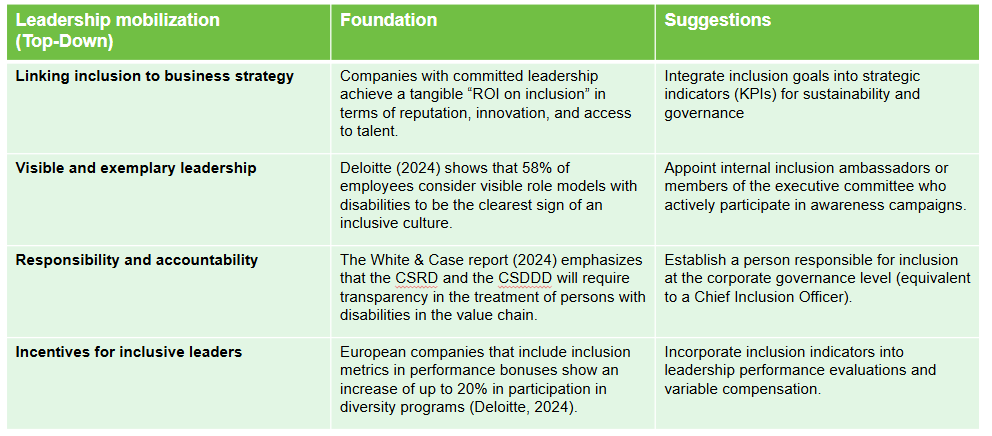
Strategies: From the Top-Down
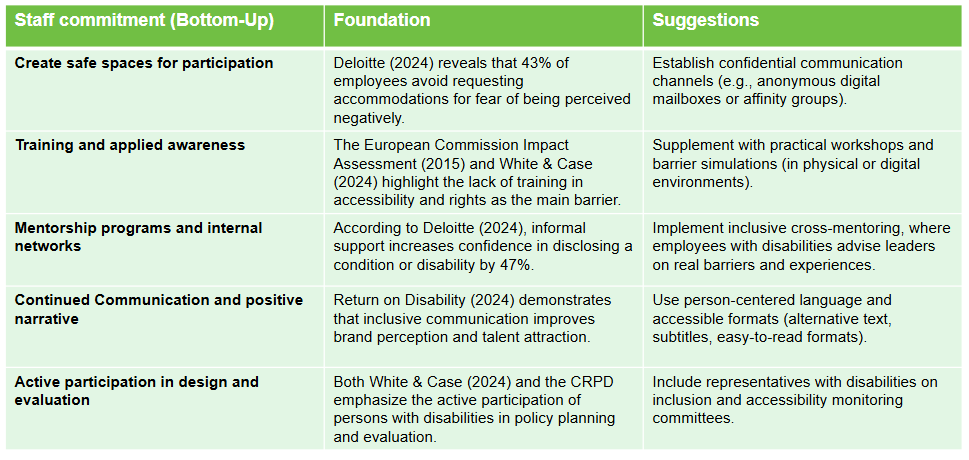
Transversal Strategies:
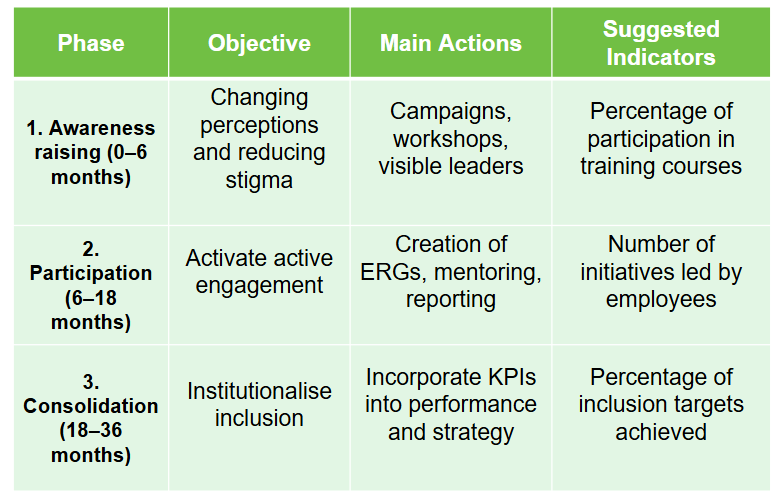
The combination of the above actions may be integrated into a three-phase inclusive culture plan like this one:
Decision Tree Exercise
Scenario Setup:
TechGlobal.SA seeks to transition from a strategy of mere formal compliance to a culture of real and sustainable inclusion.
Practical Activity
Practical Activity – Workplace Application Task
Title: Long term Strategies.
Instructions for the Learner: Keeping in mind the previous information, especially the strategies.
Task:
- Try to sketch a plan that encompasses more than 1 year.
- Describe one KPI you would introduce to your organisation in order to make sure Inclusivity is improving.
- How would you start? Top-Down? Bottom-up?
- Estimated Time to Complete: 15 minutes
Write in your notes and keep for future reference.
Case Study
Case Study – Reflection
Now that you’ve read the case study, take a moment to reflect on the following:
- Where the actions taken by the company enough to achieve what they wanted in your opinion?
Were there key moments where something small made a big difference? - If you were in the HR manager’s shoes, what would you have done the same — or differently? Would you have gone further?
Why?
Estimated Time: 5–7 minutes
Write your reflections in your notes or learning journal.
Further Resources
Title | Type | Link | Why it‘s Useful (1 sentence) |
Disability inclusion at work 2024: A global outlook. | in-depth insight into the workplace experiences | ||
ESTRATEGIA DE DESARROLLO SOSTENIBLE 2030 | Spanish plans for the SDG’s | ||
Return on Disability Group. (2024). The Global Economics of Disability 2024. | Market Perspective into disability | ||
International Labour Office (ILO). (2011). Disability in the Workplace: Employers’ Organizations and Business Networks (Working Paper No 6). ILO. | Provides insights into how representative organizations of business address the issue of disability | ||
Comisión Europea, Dirección General de Justicia y Consumidores & Risk & Policy Analysts. (2025). Business case of diversity and inclusion at work : impact of European Commission diversity and inclusion policies : final report. Oficina de Publicaciones de la Unión Europea. | LINK to DOWNLOAD | This report explores the business case for diversity and inclusion (D&I) in the workplace |
Sources and References
- Academic Network of European Disability experts (ANED). (2013). National accessibility requirements and standards for products and services in the European single market: overview and examples. (Compilado por M. Priestley). ANED.
- Aksnes, S. Y., & Ulstein, J. (2024). Sustainable Employment for People with Disabilities: A Scoping Review on Workplace Practices and Positive Employment Outcomes. Scandinavian Journal of Disability Research, 26(1), 189–210.
- Bigby, C., & Hough, A. (Eds.). (2024). Disability Practice: Safeguarding Quality Service Delivery. Palgrave Macmillan, Springer Nature Singapore Pte Ltd.
- European Commission. (2010). El Fondo Social Europeo y las Personas con Discapacidad. Unión Europea.
- European Commission. (N.d.). Persons with disabilities [Página web institucional].
- European Commission. (N.d.). Estrategia sobre los derechos de las personas con discapacidad [Página web institucional].
- Gobierno de España, Ministerio de Derechos Sociales y Agenda 2030. (2022). Estrategia Española sobre Discapacidad 2022-2030: Para el acceso, goce y disfrute de los derechos humanos de las personas con discapacidad.
- Gould, R., Parker Harris, S., & Caldwell, K. (2018). ADA Research Brief: Workplace Culture and the ADA. ADA National Network Knowledge Translation Center.
- International Labour Office (OIT). (N.d.). Apéndice: Referencias (Extractos de documentos sobre la acción sindical).
- Observatorio Estatal de la Discapacidad (OED). (2018). Casi el 30 por 100 de la población con discapacidad de la UE está en riesgo de pobreza o exclusión social.
- Pacto Mundial de la ONU (Red Española). (N.d.). Discapacidad y empresas: inclusión laboral con la Agenda 2030.
- White & Case LLP, Disability:IN, & Thomson Reuters Foundation. (N.d.). [Guía de resumen de las directivas CSRD, CSDDD y EAA]
End Of Module
Funded by the European Union. Views and opinions expressed are however those of the author(s) only and do not necessarily reflect those of the European Union or the European Education and Culture Executive Agency (EACEA). Neither the European Union nor EACEA can be held responsible for them.